Things You Should Consider When Replacing a Main Water Line
There’s a strip of grass in your yard that stays green while the rest of it goes brown in August. Or the shower pressure went soft one Tuesday and never came back. Maybe the bill jumped forty bucks and nobody’s taking longer showers.
That’s usually when the phone rings. And before we talk about replacing a main line, let’s figure out whether you actually need one.
Prove the Water’s Leaving Underground
A wet patch is evidence. It isn’t a verdict.
Here’s what I do before I quote anybody. Shut off every fixture in the house every tap, the ice maker, the irrigation then go stand at the meter and watch the little triangle. Still turning? Water’s escaping between the meter and your house. Dead still? Your problem’s inside, and we just saved you a few thousand dollars in about four minutes.
Did that last spring for a woman over in Woodland Heights who’d already made peace with losing her front lawn. Split fitting, maybe four feet off the meter box. We were gone by lunch.
Runs the other direction too. Fellow in Lakeside wanted a patch and what I pulled up was more rust than pipe.
What’s Probably Buried Out There
Richmond’s housing stock runs a couple hundred years deep, so this depends a lot on when your place went up.
Those early-1900s houses in the Fan and Church Hill often started with galvanized steel. Corrodes from the inside, which is the aggravating part a section can look perfectly sound sitting in the trench and have about a pencil’s width of opening left in it. Mid-century Northside and Lakeside homes mostly got copper, and copper’s been decent to us here. Anything from the late seventies into the mid-nineties, I start looking for polybutylene.
Age alone doesn’t condemn a line, though. I’ve dug up sixty-year-old copper in Ginter Park that was in better shape than pipe half as old, and it only came out because we were already down there.
Replacing a main line earns its keep when the material itself is quitting in more than one spot.
How They Plan to Reach the Pipe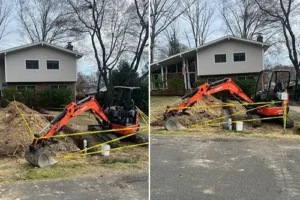
Open trench isn’t automatically the answer. Neither is trenchless, though plenty of folks show up having read about it and wanting it.
Directional boring pulls new HDPE through with two small pits instead of a scar across the lawn, and if you’ve got a willow oak you’ve babied for twenty years or a brick walk between the meter and the porch, that’s worth real money. But our clay keeps secrets. If the old line collapsed or wandered off the route somebody assumed it took, the bore quits being an option after the crew’s already in your driveway.
Two things aren’t up for discussion. Miss Utility marks the yard first that’s Virginia law, not paperwork. And city water service work needs a permit and inspection. Nobody should be replacing a main line without both, and you should know whether those fees are in your number or coming later.
Where the Cheap Bid Gets Expensive
Two estimates for replacing a main line can sit three grand apart and describe completely different jobs.
Read past the pipe. Backfill and compaction, sod or seed, concrete and asphalt patching, who reconnects at the house. Restoration is where the low number catches up with you. Watched a homeowner in Chesterfield save eight hundred up front and hand a landscaper twice that come May.
Ask about the shutoff while you’re at it. Most single-family jobs are one working day, sometimes two if inspection timing doesn’t cooperate. If you work from home or there’s a kid in diapers, that’s something to plan around not find out about at eight in the morning.
Get the scope in writing. Including what happens when we hit something nobody expected, because now and then we do.
Don’t Wait for It to Get Louder
A slow leak underground doesn’t stay slow. It washes soil out from under whatever’s sitting on top of it and bills you every month for water you never touched. Call the stubbornly honest plumbers at Five Star Services Benjamin Franklin Plumbing and you’ll get a straight answer on whether replacing a main line is warranted or whether this is a two-hour fix.
FAQ
How do I know it’s the main and not something inside?
Check the outside spigot. If pressure’s weak there before the water reaches any of your indoor plumbing, the trouble’s usually out in the yard. Weak at one bathroom only is an inside problem, and a much cheaper one.
Do y’all have to tear up my whole yard?
Usually not. Most of what we do is two access pits rather than a full trench. That said, the route and what’s already buried decide it, and older Richmond lots with brick walks and big root systems get looked at case by case.
Where does the city’s responsibility stop and mine start?
Generally, the utility side ends at the meter, and the water line from there to your house is yours. Confirm it with Richmond’s Department of Public Utilities before you pay anybody, since meter placement shifts that answer on some properties.
Can I just repair it instead?
Sometimes, and I’ll say so when that’s the case. Isolated damage in decent pipe repairs fine and lasts. But a third leak in two years means replacing a main water line costs you less than the repairs will.
How long am I actually without water?
Plan on a full working day for most houses. Permits and utility marking happen before we ever dig, so that part doesn’t cost you service. Runs under a driveway or through mature landscaping can push into a second day.
Get it looked at before you get it dug up. Half the panic calls I take turn into an afternoon’s work.