
If you’re asking yourself this question, odds are your water bill is higher than it should be and you can’t find a reason for it. There’s no wet spot anywhere, and the kids swear they haven’t been taking hour-long showers. I’ve had that conversation with a lot of homeowners around Richmond, and more often than not there’s a hidden leak, it just isn’t anywhere they’ve thought to look yet.
How Much Water a Leak Can Actually Waste
The numbers get bigger than people expect. EPA’s WaterSense program says a faucet dripping once a second adds up to more than 3,000 gallons a year, and a toilet that runs constantly can waste around 200 gallons a day. And those are leaks you’d notice if you were paying attention.
A hidden leak behind a wall or under a floor worries me more, because nobody’s paying attention to those. I had a customer in Chesterfield a while back whose bill crept up for three months before she called. She’d already changed out a faucet cartridge thinking that would do it. It turned out to be a pinhole in a supply line behind her bathroom vanity misting into the insulation the whole time with no water dripping anywhere she could see.
Start With the Toilets
Before anybody goes looking for a hidden leak inside a wall, I’d check the toilets, because that’s where I find the problem alot of the time. The flapper in the tank wears out over a few years and starts letting water seep into the bowl, you might hear the tank refill now and then, or you might not hear anything.
To check it, put some food coloring in the tank and don’t flush for 15 minutes. If the color shows up in the bowl, you need a new flapper, which is a ten to fifteen dollar part from Fluidmaster or Korky and something most people can swap themselves.
The dye test won’t tell you about a leaking wax ring or supply line, though. If the floor around the toilet feels soft, that’s past DIY and you should call someone.
Checking Your Water Meter
Your water meter is the best tool you’ve got for this, and most people never look at it. It’s usually in a box near the street with a lid you can pry up. On the face there’s a small dial, often a little triangle or star, called the low-flow indicator, and it’ll spin even when the flow is too small for you to notice.
Turn off everything in the house that uses water, including the ice maker and the washer, and then watch that dial for a few minutes. If it’s turning, water’s going somewhere. For a slower leak you can write down the reading before bed and check it again first thing in the morning.
That tells you there’s a hidden leak, it doesn’t tell you where. Finding where is a different job.
How a Plumber Finds a Hidden Leak
I get why people are nervous about this part. Nobody wants somebody cutting into the plaster in an old Fan District house on a guess, and a good plumber shouldn’t be doing that anyway.
Leak detection is mostly a process of elimination. We’ll isolate parts of the system and pressure-test them, listen with acoustic equipment, and use a thermal camera to look for temperature differences where a wall or floor is wet. Usually that gets us right to it in an hour or two.
It doesn’t always work, though. Plaster muffles sound, and in houses sitting on crawlspaces a leak can drip onto the dirt for months without showing up inside. Sometimes we get it within a couple feet and have to open one small spot to confirm.
Don’t Let It Sit
The longer a hidden leak runs, the less the water bill matters, since you’re soon paying for subfloor and mold cleanup. Cutting holes to hunt for it yourself makes it worse. We’re stubbornly honest plumbers, so we’ll tell you what we find and what it costs before we touch anything. Call Five Star Services Benjamin Franklin Plumbing in Richmond.
FAQ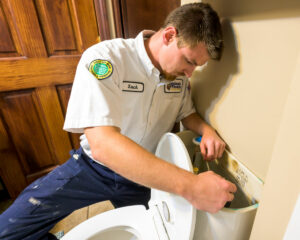
How much water can a hidden leak waste in a month
Depends on the size. A toilet running nonstop can waste around 6,000 gallons a month. Supply lines stay under pressure, so even a small one keeps leaking while you sleep.
My bill went up but nothing looks wet, could it still be a leak
It could. Rule out the obvious first, like more lawn watering in summer. If nothing’s changed, do the meter test, and if the low-flow dial moves, there’s a leak somewhere.
Do I need a permit to fix a leaky pipe in Virginia?
Not for most small repairs. Replacing the main water line or repiping generally needs one under Virginia’s Uniform Statewide Building Code. Richmond and the surrounding counties run their own permit offices, and we handle that.
Can you find it without tearing up my walls
Usually, yes. Pressure testing and acoustic equipment narrow it down before anything gets opened. If we need access, it’s one small spot.
Is a small drip worth calling a plumber over
A faucet drip you can see can wait a weekend. Water dripping somewhere you can’t see is different. A few months of that inside a wall turns a pipe repair into a drywall job.
If you check the meter tonight and the dial’s not moving, you probably don’t have a hidden leak, so go get some sleep.