How High Should You Hang Your Chandelier Over a Table?
You know what question I get asked more than almost anything else on jobsites? It’s not about panel upgrades or smart switches. It’s this: “How low should this chandelier go?”
And honestly? I get it. Hang it too high and it looks like it’s floating away from the table. Too low and someone’s going to walk face-first into crystal. There’s a sweet spot, and finding it isn’t just about following some rigid rule—it’s about understanding the space and what actually works.
The Standard Height (And Why It’s Just a Starting Point)
Here’s the baseline: your chandelier should hang 30 to 36 inches above the table surface. That’s the range you’ll see repeated everywhere, and for good reason—it works in most dining rooms with standard 8-foot ceilings.
But—and this is important—that’s not a law carved in stone. I’ve installed chandeliers at 28 inches in rooms with lower ceilings and at 40 inches in spaces with soaring 12-foot heights. The fixture needs to feel right in the room, not just check a box on some measurements.
Think about it this way: if everyone seated can see across the table without the fixture blocking sightlines, and no one’s going to bump their head standing up, you’re in good shape.
Adjusting for Ceiling Height
Standard ceiling? That 30-36 inch rule works great. But what happens when you’re working with 10-foot ceilings? Or a two-story entryway situation?
Add 3 inches of hanging length for every foot of ceiling height above 8 feet. So if you’ve got 10-foot ceilings, you’re looking at 36 to 42 inches above the table. At 12 feet? You might go 42 to 48 inches.
I once did an install in a converted warehouse with 14-foot ceilings. The homeowner kept saying it looked “too high” when we mounted it at the standard height. We dropped it another 6 inches and suddenly everything clicked. Sometimes you need to trust your eyes more than your tape measure.
Sizing the Chandelier to Your Table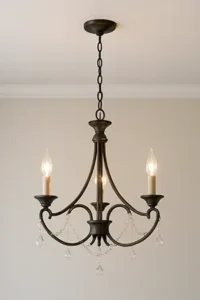
Width matters. A lot.
The general formula: your chandelier diameter should be about half to two-thirds the width of your table. So a 48-inch wide table? You’re looking at a 24 to 32-inch chandelier. Simple math, but it makes a huge visual difference.
Too small and the fixture looks lost, like it wandered into the wrong room. Too big and it overwhelms everything. I’ve seen 18-inch fixtures over 72-inch tables that looked ridiculous—and I’ve seen the opposite problem just as often.
For round tables, match the chandelier shape. Round table, round chandelier. It just looks better. Rectangular tables give you more flexibility—you can go with a traditional chandelier or even a linear fixture that runs along the table’s length.
When to Use a Linear Chandelier
Got a long dining table? Like 84 inches or more? This is where linear chandeliers shine.
A single round chandelier over a long table creates dead zones of light at the ends. Stubbornly honest electricians will tell you straight up: one fixture just won’t cut it for those longer spans. You need either a linear chandelier that stretches most of the table length, or you install two smaller chandeliers spaced evenly.
I usually recommend the linear route for tables over 7 feet. It provides even light distribution and looks intentional rather than like you couldn’t decide where to put the fixture.
Room Size Considerations
Don’t forget the room itself. A chandelier that looks perfect over your table might still feel wrong if the room dimensions are off.
Quick sizing method for the room: add the room length and width (in feet), then convert that number to inches. That’s your chandelier diameter. So a 12-foot by 14-foot room? That’s 26 inches for your chandelier diameter.
But here’s the thing—this is for the room, not necessarily the table. You might need to split the difference if the math doesn’t line up perfectly with your table sizing. Use common sense. Does it look balanced? That’s your real answer.
Fixture Height Itself Matters Too
Here’s something people forget: the actual height of the fixture. A 12-inch tall fixture hangs very differently than a 36-inch tall one.
If you’ve got a substantial chandelier with lots of vertical drama, you might want to raise it slightly above that standard 30-36 inch range. The bottom of the fixture is what matters for clearance, but the visual weight of the whole piece affects how it feels in the space.
I worked on a farmhouse with this gorgeous tiered chandelier that was about 40 inches tall. We had to hang it 38 inches above the table because anything lower made the whole room feel cramped. The size of the fixture demanded more breathing room.
Brightness, Bulbs, and Dimmers
While we’re talking about chandeliers, let’s discuss the light itself. This isn’t just decorative—it needs to actually light your table.
Install a dimmer. Always. I don’t care if you think you won’t use it. You will. Dinner parties need different light than Tuesday night homework sessions. A dimmer gives you flexibility, and they’re cheap insurance against buying a fixture that’s too bright.
For bulb brightness, aim for about 200 to 400 lumens per bulb depending on how many bulbs you have. Five-bulb chandelier? You’re looking at roughly 1500 to 2000 total lumens, which translates to about 100 to 150 watts if you were using traditional incandescent (though LED equivalents use way less power).
FAQ
What if my chandelier is too big for the standard hanging height?
If the fixture itself is tall and hanging it 30-36 inches above the table would put the bottom too low, raise it up. The key measurement is that bottom clearance—you need at least 30 inches, preferably 32. Adjust upward from there.
Can I hang a chandelier in a room with 7-foot ceilings?
You can, but go smaller and shallower. Look for fixtures under 20 inches in height and plan to mount closer to 28-30 inches above the table. Otherwise the room will feel claustrophobic.
Should the chandelier be centered on the table or the room?
Center it over the table, not the room. Unless the table is permanently fixed in place and also happens to be room-centered. The chandelier serves the table first.
How do I know if I need two chandeliers instead of one?
If your table is longer than 7 feet and a single fixture would need to be huge to provide even coverage, consider two smaller fixtures or one linear fixture. Two fixtures spaced evenly usually look better than one oversized piece.
What about open floor plans where the dining table is visible from other rooms?
You’ll want to consider sightlines from adjacent spaces. The chandelier becomes a focal point from multiple angles, so make sure the size and hanging height work from all viewing positions—not just when you’re seated at the table.
Look, installing a chandelier isn’t rocket science, but it does require thinking about more than just one measurement. Get the height right for your ceiling, size it properly for your table and room, make sure the bottom clearance works, and trust your eyes. Sometimes the “right” answer is the one that just looks and feels correct when you step back and take in the whole space.