Can an Electrical Inspection Identify Fire Hazards?
Your breaker keeps tripping, and you keep resetting it. That’s usually the whole conversation, until it isn’t. I’ve been in Richmond attics finding scorched insulation on wiring that looked completely fine an hour earlier from the hallway. Fire hazards don’t announce themselves. They build quietly behind drywall, and most homeowners never see one until something fails.
What an Inspection Actually Covers
The panel’s first, since that’s where I’ve found the worst surprises corroded lugs, breakers doubled up where they shouldn’t be, a scorch mark from a roof leak nobody mentioned. From there it’s wiring connections, grounding, outlet load, GFCI and AFCI protection, and anything visible in the attic or crawl space.
Rodents chew wire more than people expect in older neighborhoods with mature trees close to the house. A real inspection isn’t a five-minute glance. It usually runs 45 minutes to two hours depending on the home’s age and panel size. I can’t promise I’ll catch a wire buried inside a finished wall with no access point. But I can tell you what the visible signs say, and that’s where most fire hazards actually start.
The Wiring Problems That Actually Start Fires
Most electrical fires don’t come from one big failure. They come from a loose connection that’s been getting warmer for months. A homeowner over on Monument Avenue called me last year because her kitchen outlet felt warm turned out a wire nut had backed off years earlier and nobody noticed.
Overloaded circuits are just as common, especially in homes built before anyone owned an air fryer, a home office, and an EV charger at the same time. Add an aging panel with worn breakers and you’ve got a setup where fire hazards can develop even though every light in the house still works fine. None of this means your home is doomed. It means the wiring hasn’t caught up with how much power you’re actually pulling through it.
Signs You Shouldn’t Wait On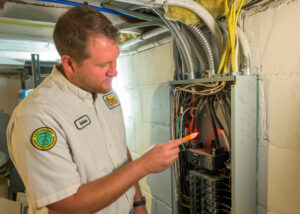
Flickering lights, a burning smell near an outlet, a breaker that trips every time you run the microwave homeowners tell me “it’s been doing that for years” more than you’d think. Electrical systems don’t fix themselves. Buzzing switches, discolored receptacles, extension cords doing the job of permanent wiring those are all things I’d want to see in person.
Some of it turns out minor. A loose screw, a worn switch, nothing dramatic. Other times it points to genuine fire hazards building behind the wall, and there’s no way to tell which one you’ve got without someone opening things up and testing them. If your gut says something’s off, it usually is.
Older Richmond Homes Need a Closer Look
A lot of Richmond’s housing stock the Fan, Church Hill, Ginter Park was wired for a family with a radio and a couple of lamps, not a modern kitchen and a garage full of chargers. That doesn’t automatically make a 1940s panel dangerous. Plenty of them are still doing fine.
But age combined with modern electrical demand is exactly the combination where fire hazards start showing up, and older homes sometimes have wiring types cloth insulation or aluminum branch circuits that need a trained eye to evaluate properly.
If you’re buying an older home or you just finished a renovation without pulling a permit, that’s worth an inspection before you assume everything’s fine.
Don’t Wait on a Warm Outlet
We’re Five Star Services Mister Sparky, and we’ve built our name on being the stubbornly honest electricians who’ll tell you the truth about your panel instead of the story that gets you to sign faster. Waiting on a flickering light or a warm outlet rarely ends well, and DIYing a breaker swap wrong can turn a small fix into a real problem fast. Call before it becomes one.
Frequently Asked Questions
Can an inspection actually catch a wiring problem before it becomes a fire?
Most of the time, yes. We look for heat damage, loose connections, and overloaded circuits the conditions that turn into fire hazards long before smoke ever shows up. We can’t see inside every wall, but visible warning signs usually tell the story.
How long does an inspection take?
Usually 45 minutes to two hours, depending on your panel and how old the wiring is. Homes with additions or unpermitted work sometimes take longer because there’s simply more to check.
My breaker keeps tripping, should I just keep resetting it?
No. A breaker that trips repeatedly is doing its job warning you about conditions that can turn into fire hazards if you ignore them long enough. Resetting it over and over doesn’t fix anything, it just delays finding out what’s wrong.
Are older homes more likely to have fire hazards?
Generally, yes. Aging panels, outdated wiring types, and electrical demand way beyond what the system was built for all raise the risk. It doesn’t mean something’s wrong, just that it’s worth checking.
Is it worth inspecting a house if nothing seems wrong?
Honestly, some of my favorite visits are the ones where we find almost nothing. But quiet problems are still problems, and catching them early is a lot cheaper than fixing them after something fails.
Most of the calls I get start with “it’s probably nothing.” Sometimes it is. But you don’t find out by ignoring it you find out by having someone look.
