Why Is My Air Conditioner Blowing Warm Air?
You walk in after a long day, the thermostat reads 72, and the vents are pushing out warm air like they’re mocking you. The whole house feels like a parked car. If your AC’s running but the Richmond heat won’t let up, here’s what’s actually going on starting with the cheap fixes before we get to the expensive ones.
Start with the thermostat and filter
Before you panic, check the boring stuff. I’ve lost count of the calls that ended at a thermostat flipped to “Fan” instead of “Cool.” The blower runs, room-temperature air moves around, and nothing cools. Two-second fix.
Then the filter. A clogged one chokes airflow until the system overheats or the coil freezes, and a frozen coil sends warm air right back through your vents. Check it monthly through the summer.
Here’s the caveat: if the filter’s clean, the thermostat’s right, and you’re still getting nothing cool, stop poking around. That usually means the trouble runs deeper than anything you’ll fix from the hallway.
When the outdoor unit’s the problem
That big metal box outside dumps the heat your system pulls from the house. When it can’t breathe, the heat has nowhere to go, and you get warm air indoors.
Around Richmond, the usual culprits are grass clippings after mowing, cottonwood fluff in early summer, and caked mud on older units in yards near the James. I had a homeowner over in Bon Air whose condenser was packed solid with oak leaves cleared it out, and the system was cooling within the hour.
Shut the unit off at the disconnect, hose the coils gently from the inside out, and keep a couple feet of clearance around it. That part’s fair game. Just leave bent fins and anything electrical inside the cabinet alone that’s where DIY starts costing money.
Low refrigerant and frozen coils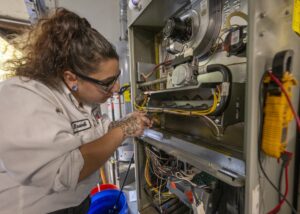
Refrigerant is what moves heat out of your home, and it doesn’t get used up. If you’re low, you’ve got a leak. Watch for warm air at the vents, ice creeping along the copper lines outside, a faint hiss, and cooling cycles that never seem to end.
This is where the DIY road ends. You can’t grab refrigerant off a shelf handling R-410A or the newer R-454B takes EPA certification, and topping off without finding the leak just wastes money. It’s a federal code issue, not a suggestion.
A frozen evaporator coil ties into the same story. Low charge or weak airflow lets it ice over, and a block of ice can’t cool a thing. If you see ice, shut the system down and let it thaw before a tech shows up running it frozen can wreck the compressor.
When it’s electrical, and when to call us
Modern cooling systems lean on a stack of electrical parts capacitors, contactors, relays, the breaker. When one fails, the indoor fan often keeps humming while the outdoor unit sits dead, so warm air keeps circulating even though nothing’s cooling.
A bad capacitor is the most common offender I see. Cheap part, but testing and swapping it means working around charged components, and that’s not a place to learn on the fly.
A homeowner near Church Hill once reset a tripping breaker four times before calling. Turned out a shorted contactor was the real problem, and the repeated resets had cooked the wiring cost a lot more than the original fix would have. If your breaker won’t stay set, the system’s telling you something. Don’t argue with it.
Warm air on a 95-degree Richmond afternoon isn’t something to ride out for a week small faults turn into compressor failures fast. Five Star One Hour Heating and Air sends out stubbornly honest AC repair techs who’ll find the real cause, tell you straight what it costs, and skip the repairs you don’t need.
Frequently Asked Questions
Why’s my air conditioner blowing warm air but the fan still runs?
Usually, the outdoor unit quits due to a dead capacitor, refrigerant trouble, or a tripped breaker, while the indoor blower keeps going. You get air movement but no cooling. A tech needs to find which part failed.
Can a dirty filter really cause this?
Yes, more often than people think. A clogged filter starves the system of airflow, the coil freezes, and once it’s iced up you’ll feel warm air at the vents. Change the filter and let any ice melt fully first.
How do I know if I’m low on refrigerant?
Watch for vents that never blow cold, ice on the lines outside, a hiss, and cooling cycles that drag on. Climbing power bills are another tell. Low charge always means a leak it doesn’t vanish on its own.
Should I shut it off if it’s not cooling?
If you see ice on the coil or lines, yes running a frozen system can damage the compressor. Otherwise it’s fine to leave on briefly. When in doubt, switch it off and call before it gets worse.
Does maintenance actually prevent this?
It helps a lot. An annual tune-up catches weak capacitors, low charge, and dirty coils before Richmond’s July heat finds them. Most summer breakdowns I see trace back to something a spring check would’ve flagged.
Don’t sweat it out hoping it sorts itself it won’t. Give us a call and we’ll get the house cool again.