What Size Chandelier You Should Choose for a Dining Room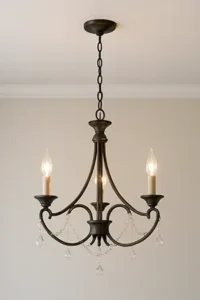
Look, picking a chandelier shouldn’t feel like defusing a bomb, but somehow it does. You’re standing there in the lighting showroom, staring at 47 different fixtures, and every single one looks perfect under those professionally aimed spotlights. Then you get it home, hang it up, and… something’s off. It’s either swimming in space like a lost marble or dominating the room like an angry disco ball.
Here’s the thing nobody tells you upfront: most chandelier disasters aren’t about taste. They’re about math you didn’t know you needed to do.
The Table Width Rule (Use This First)
Start here, because it’s simple and it works.
Your chandelier should measure somewhere between half and two-thirds the width of your dining room table. That’s the sweet spot. So if you’ve got a 48-inch-wide table, you’re looking at a chandelier that’s roughly 24 to 32 inches across.
Why? Because the chandelier needs to visually connect to the table, not float around like it’s waiting for a different piece of furniture to show up. The table is the star. The chandelier is the lighting.
I watched someone hang a delicate 18-inch fixture over a massive 84-inch farmhouse table once, and honest to God, it looked like a Christmas ornament that got separated from its tree. We swapped it for a 42-inch piece and suddenly the whole dining room made sense again.
The Room Formula (Helpful, Not Gospel)
Here’s a quick sizing trick designers love: add your room’s length and width in feet, then convert that number to inches for your chandelier diameter.
So a 12-foot by 14-foot dining room? That’s 12 + 14 = 26. Aim for about a 26-inch chandelier.
It’s a decent gut check, especially for traditional dining rooms with four walls and a door. But if you’re dealing with an open floor plan where the dining room bleeds into the kitchen, or your table is unusually large for the space, lean harder on the table measurement. People eat at the table, not at the walls.
Chandelier Height Matters More Than You Think
Everyone obsesses over width and forgets about height until the fixture arrives and suddenly it’s either a pancake or a stalactite.
Here’s a reasonable starting point:
- 8-foot ceilings: look at chandeliers around 17–24 inches tall
- 9-foot ceilings: bump it to 20–28 inches
- 10-foot ceilings: go 24–36 inches, maybe more if the style supports it
If your chandelier has a lot going on—crystal drops, multiple tiers, ornate metalwork—keep the height on the conservative side. You want elegant, not suffocating.
Hanging Height: The Part Everyone Gets Wrong
This is where people panic about head injuries and hang the thing so high it might as well be a ceiling fan.
Standard rule: the bottom of your chandelier should sit 30 to 36 inches above the table surface.
For taller ceilings, add about 3 inches of height for every additional foot of ceiling. So with 10-foot ceilings, you might end up 36 to 42 inches above the table. That keeps it in the conversation instead of hovering in orbit.
And yes, you will adjust it seventeen times before you’re satisfied. That’s completely normal. Welcome to dining room ownership.
Shape Matching Changes Everything
Half the time when someone says their chandelier is the wrong size, the real problem is shape.
Got a long rectangular table? You want a chandelier that extends horizontally—something linear, or at least wider than it is tall. Round tables do better with round chandeliers, compact clusters, or symmetrical lantern shapes.
I’ve seen long skinny fixtures over round tables and it’s like watching someone wear a belt as a headband. Technically it’s an accessory. Emotionally it’s confusing. Match shapes and your dining room will instantly feel more pulled together.
Light Output Isn’t Just About Wattage
A huge chandelier with tiny bulbs can still feel dim. And a small chandelier with aggressive LEDs can turn dinner into an interrogation.
Do yourself a favor, get dimmable bulbs and put that chandelier on a dimmer switch. Your dining room needs to handle Tuesday night homework and Saturday dinner parties. Those are not the same vibe.
Think warm glow, not operating room. You want people to see their food, not examine it for forensic evidence.
Stubbornly Honest Electricians
Here’s what I’ve learned after too many installs, chandeliers don’t fail because people can’t measure. They fail because someone bought what looked cool online and nobody had the guts to say, “Hey, that’s not going to work in your space.”
That’s why I appreciate stubbornly honest electricians. The ones who’ll tell you straight that the fixture you love is going to look tiny, or that it’ll blind everyone at the table without a dimmer. It’s not rude. It’s saving your dining room from looking like a Pinterest fail.
FAQ
How big should a chandelier be for a small dining room?
Stick with the half-to-two-thirds rule based on your table width, but keep the height compact. In tight spaces, a smaller fixture with strong design usually beats an oversized statement piece that crowds everything out.
Can a chandelier be wider than the table?
Technically yes, but I wouldn’t recommend it. Once your fixture extends past the table edges, it starts feeling disconnected and can mess with sightlines. Keep it narrower than the table for best results.
What if I have a really long table—should I use two chandeliers?
For tables over 8 feet long, two smaller fixtures or one linear chandelier often works better. It spreads the light more evenly across the dining room and avoids that awkward single-light-source situation.
Does ceiling height change what size chandelier I need?
Absolutely. Taller ceilings can handle more vertical presence, but you still need to keep the bottom of the fixture in the right zone above the table. Don’t let it drift up into the stratosphere just because you have the ceiling height.
Should I center the chandelier on the room or the table?
Always center it on the table. The table is the main event in your dining room, not the room’s architectural geometry. Even if it looks slightly off-center from the doorway, trust me—it’ll look right when people sit down to eat.